Teeth Whitening

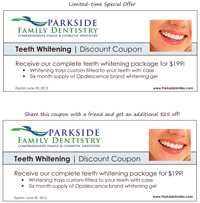
Click through to print our coupon and referral deal!
Parkside Family Dentistry offers a great teeth whitening solution for everyone and for a limited time, you can receive our incredible whitening kit for only $199! This deal is only good through July 2013 so act now to receive:
-
A Dental Tray, Made Custom by Our Dental Team, and Case
-
and a Six Month Supply of Safe and Easy-to-Use Whitening Gel, by Opalescence
So call 1-540-212-4279 to take advantage of this deal today!
Your Teeth
Your teeth are made of two layers- enamel and dentin. Enamel is the white protective layer of the tooth. Damage to the enamel can expose your dentin. Dentin is the core of the tooth. It also has a darker, yellow color. In addition to that, cracks in the enamel can fill with staining substances, like dark foods. If left for a long time untreated, stains can be difficult to remove.
Professional teeth whitening has been proven as safe and effective, grounded in simple science. The whitening chemicals, oxidizing agents, react with the foreign substances to break down and remove them more thoroughly than simply brushing your teeth can. Once the stains are removed, saliva will fill some cracks and remineralize but regular teeth whitening is necessary to maintain white teeth.
How Whitening Works
There are many products and techniques available for patients who want to achieve a whiter smile, and with so many options available, it can be difficult to choose the method that is right for you. The best way to begin any teeth whitening regimen is to schedule an appointment and talk to your doctor about the differences between in-office professional whitening and at-home whitening.
With teeth whitening, there are two different active ingredients that you could be using- carbamide peroxide and hydrogen peroxide. If you’re using an at-home treatment, it should be listed on the packaging. Otherwise, ask your dentist.
Both active ingredients actually end with hydrogen peroxide as the whitening chemical, as carbamide peroxide reacts with water to make hydrogen peroxide. The fact that carbamide peroxide has to react first makes it much weaker- about a third of the strength of hydrogen peroxide. That means a 30% carbamide peroxide solution is about the strength of a 10% hydrogen peroxide solution.
Hydrogen peroxide is much more powerful and much more likely to irritate your gums or increase teeth sensitivity. Your dentist can carefully control the negative effects so that they are kept to a minimum and no solution comes in contact with your gums.
Due to the gentler strength carbamide peroxide, it is ideal for at-home whitening kits where a professional is not available and dentists agree that the key to long term teeth whitening is regular at-home treatment. Take-home kits are significantly cheaper than in office teeth whitening and significantly more effective than store-bought whitening strips or brush-on whiteners.
In the dental office, before-and-after tooth color is typically measured with shade guides. These are hand-held displays of wide ranges of tooth colors, arranged from light to dark. Dentists also use them in choosing crown and other restoration shades. (To avoid the mismatched color, tooth-colored restorations will probably need replacement after whitening. If cosmetic restorations are part of your treatment plan, they should not be placed for at least of two weeks after your whitening to ensure proper bonding, function and shade matching.)
Teeth Whitening Results
While whitening can occasionally lighten tooth color by nine or more shades, most of those who bleach their teeth are likely to see a change of two to seven shades. The results are not fully seen until approximately two weeks after bleaching. This is an important consideration if you are about to have ceramic restorations and want to be sure the color matches that of your newly bleached teeth.
Teeth whitening results are subjective, vary from person to person. Many are delighted with the outcome, while others may be unhappy. Realistic expectations can make the difference between joy and disappointment. Before any whitening treatment, ask your dentist for an idea of the results you are likely to achieve and how long it should take to get there.
Some factors that can affect the color of your teeth include the following:
-
The color your teeth started. Natural tooth colors can range from yellow-brownish to greenish-grey. Yellow-brown is usually easier to whiten than green-grey.
-
Your age. Tooth color is lighter in younger people, such as teenagers, because they simply haven’t had enough time to acquire more than surface, or “extrinsic” stains. In such cases, the desired results of teeth whitening are usually easy to achieve. The older you are, the more likely it is that stubborn (intrinsic) stains have sunk deep into your teeth This does not mean whitening is impossible, just harder.
-
What you eat. Consuming dark-colored, sugary, or acidic foods and liquids are a common cause of stains. Smoking tobacco products is another common cause, as nicotine leaves brownish deposits which slowly soak into the tooth structure and cause intrinsic discoloration.
-
Teeth grinding or trauma caused by falls or injuries can cause many cracks that will fill and stain over time.
-
Some teeth are thinner and more translucent, and therefore appear less white. According to cosmetic dentists, transparency is the only condition that cannot be corrected by any form of teeth whitening.
In-office teeth whitening
The first professional option is commonly referred to as “in-office” whitening. This procedure is performed in a dental office. An in-office whitening treatment may include the use of a whitening lamp or laser to enhance the effectiveness of the whitening gel by accelerating the peroxide.
During an office visit, your dental professional will apply the whitening gel and, depending on the system being used, will shine a light source directly onto the teeth. The entire office visit generally takes about 90 minutes with immediate results. The dentist generally cleans your teeth and places some sort of protective barrier on your gums before the whitening begins. The gels sits on your teeth for several minutes before the dentist washes it off. It is usually reapplied several times before the procedure is over. Many people report increase sensitivity in their teeth during this process but new gels contain sodium fluoride, which reduces this side effect significantly.
At-home teeth whitening
Tray bleaching
Tray bleaching is a type of professional whitening that uses custom-made trays and whitening gel only available through your dentist. The whitening gel is placed in custom-fitted trays that fit perfectly over your teeth. As the peroxide in the gel breaks down, hydroxyl radicals help whiten stained teeth. Unlike strips, this process whitens all your natural teeth and may contain ingredients intended to provide maximum comfort. At-home professional tray whitening generally takes 10-14 days, although you may notice results in as little as three to five days. A similar gel to the one used in office will be in your kit, but in most cases it is a less potent formula. The gels in these trays are less powerful but worn for a longer period of time, often overnight while you sleep. A combination of in office and at home whitening is key to long term whitening success.
Paint-On Whiteners, Whitening Strips, and Whitening Toothpaste
Many over the counter teeth whitening options are available but their success is limited. The active ingredients are often too weak to be noticeable. Even when the strength is enough to make some difference, many people apply the products incorrectly or there are design errors that minimize the effects. Whitening strips do not work well for teeth that are not perfectly straight and toothpaste does not remain on your teeth long enough for the whitening agents to start working. It is always the best idea to consult your dentist before using a teeth whitening solution.
If you would like to learn more about teeth whitening, please contact our practice to schedule an appointment, or visit Opalescence.com for additional information about teeth whitening.